Drawing from life
I have to confess to having a model railway in my loft and I thought it might be interesting to capture one my locomotives as a drawing. I set this sill life up and photographed it in case it got distrubed.

As you can see at the bottom of the picture I then proceed to sketch the outline onto tracing paper not the actual paper I’d use for the actual drawing as I like to keep that really clean and free of mistakes. At least that was the plan as I am not the tidiest worker!
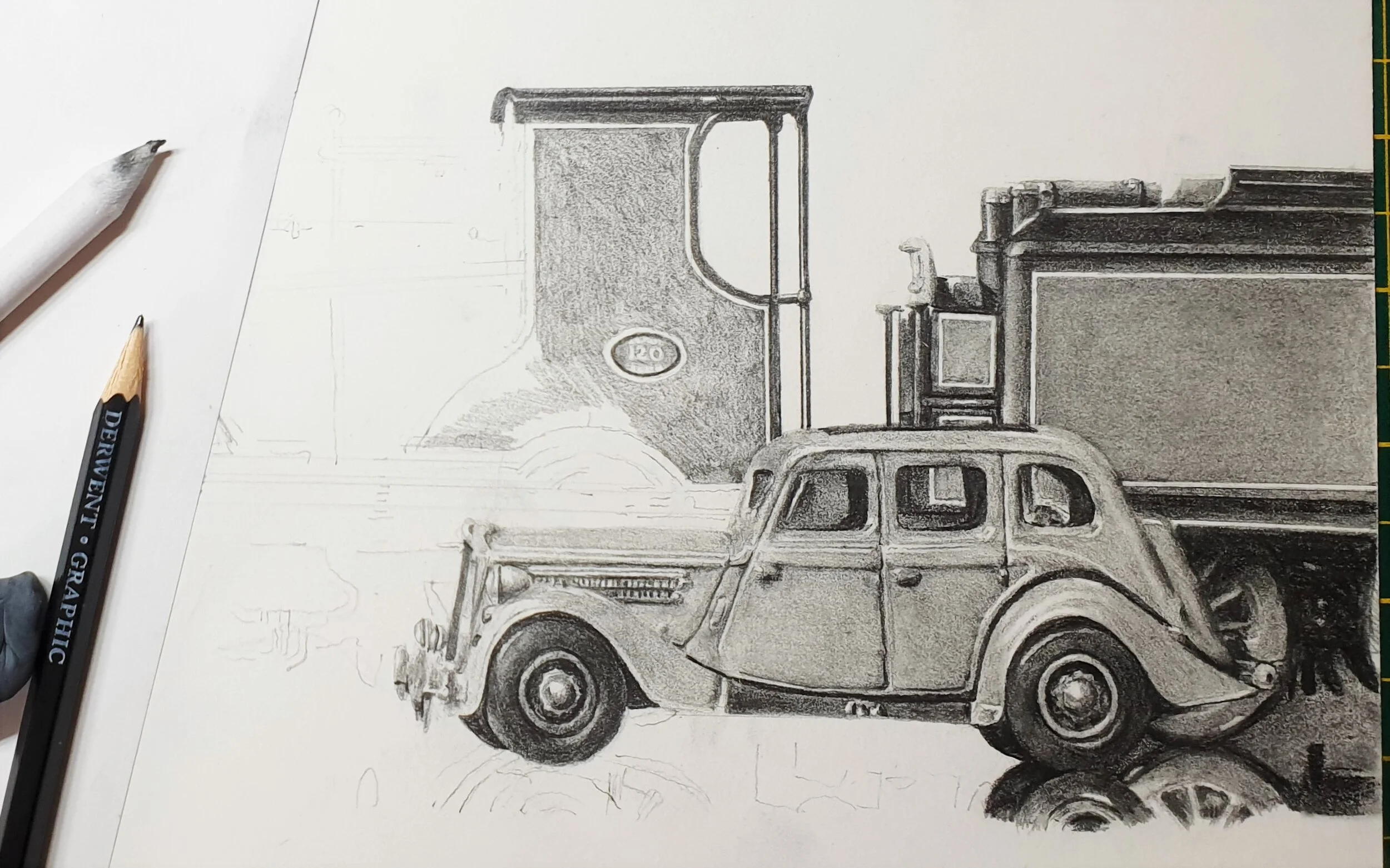
Soft pencils smudge really really easily, and being left handed I start on the right and have my lighting coming from the right as well so my hand does not cast a shadow where I am working

I am a leftie
Another thing to note above is to move the drawing around especially when working on curves to get your hand at the centre of the circle or curve you are trying to draw.
On of the many challenges in drawing man-made things is the gradual change of tone over an essentially flat areas like the sides of the locomotive. So I tried and shaded with even pressure flatten that with a tool called a stump. A stump is the white thing on the left it’s just tightly rolled paper and it can be used to smudge or apply graphite form rubbing a pencil on sandpaper. So using a stump for these even areas was the key to the even flat look you can see here. The finishing touch is to rework any unevenness with a harder (H-2H) pencil to even things out even more. On the subject of changing pencils it’s a bit like painting with numbers where I try and use the same grade of pencil for the same things like those side panels:
9 shades of grey pencil
Other general tips I would share are:
Keep looking at the subject, it’s very easy to get lost in your drawing
regularly stand back and look at the whole piece for overall tone and that the relative tones of highlights and shadows compare well to the original
Develop your critical eye. You need to be the hardest judge of your work to improve. techniques to help you are to hold your work up to a mirror, or take a picture of it on your phone. Both of these help you to analyse where areas need more work.
Take a break every half an hour, stretch move loosen the shoulder and get a drink. This is using your brain at nearly 100% capacity and you can get very tense with the concentration.
After 24 or so hours of work here is the finished article:

T9 greyhound done with 8-9 pencils a stump sandpaper rubber and good quality paper